


Today, we have a guest essay from our friend Susan Wind, a mom and environmental advocate, who has been bringing attention to public health problems associated with toxic coal ash since her daughter was diagnosed with thyroid cancer at age 16.
When she learned that most of her neighbors had cancer too, she decided to do something about it. She sees a real connection between what happened in her neighborhood and what’s happening right now with hyperscale data centers going up in communities across the country.
We talked with Susan in 2021 so if you want to hear more of her story, check out this interview:

For years, I’ve been encouraging people to get plugged in to local politics. One of the best ways to get involved is to simply to show up to your public meetings, whether that’s city council, a board of supervisors, a public works commission, or any town hall meeting.
Decisions about local policies, whether it’s raising taxes, funding new parks, or approving new water treatment techniques, are made at these meetings.
We need to show up!
Most of these meetings involve a few elected or appointed people talking to themselves. A small group deciding on issues for the whole town? That’s where I’ve always thought we could have more influence. Tell them what you care about.
Now, more people are showing up. But guess what? We are discovering a lot of corruption and/or elected officials that don’t want to listen to the people. They have signed NDAs. They paperwork is already signed and construction has started.
We need more transparency as people show up to discuss issues with massive AI data centers in their communities—from persistent noise pollution to dwindling water supplies to sky-high energy bills.
Susan’s essay explains exactly what’s at stake when it comes to hiding information. And believe me, the truth always comes out.
Same Playbook, Different Poison
by Susan Wind
Watching everyone in our country fight massive AI data centers being shoved into their communities hits a nerve. Residents didn’t ask for them. Yet, industry executives and politicians keep brokering these deals behind closed doors with zero regard for the people they’re supposed to represent.
I know this story because I lived it. In Lake Norman, North Carolina, I exposed how Duke Energy sold toxic coal ash as construction fill from the 1990s through 2014. Developers used it to build neighborhoods, putting this waste under schools, homes, parks, and businesses with no regard to human health.
State records from the 1990s prove it: agencies were told by the utility it was “safe and beneficial for all parties.” Politicians rubber-stamped it. The price was poisoned soil, poisoned water, and families left to fight cancer.
I did not ask for my kid to get cancer.
Ask anyone: Do you want toxic coal ash laced with radium and arsenic in your yard? What will they say?
Ask them: Do you want sewage sludge in your yard? What will they say?
Now ask them: Do you want a data center in your backyard? What do you think they’ll say?
We never get a choice about what’s forced into our neighborhoods.
For once, in a country torn apart for years, people from all walks of life agree on something. We don’t want a damn AI data center in our backyard.
The resistance is growing, and it’s crossing every line politicians use to divide us.
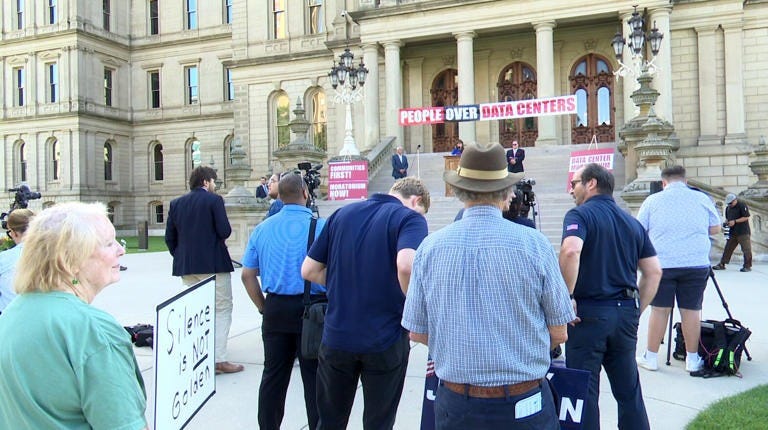
Just this week, residents and lawmakers gathered at the Michigan Capitol for a “People Over Data Centers” rally, demanding transparency as data center proposals multiply across the state. The rally was led by Republican legislators pushing for a one-year moratorium on new data center development.
You know who showed up? Liberals and conservatives, farmers and environmental advocates, city people and country people.
“True progress does not require us to sacrifice our peace, our natural resources, and our need for transparency from local government,” said Marshall resident Holly Harnden who attended the rally.
These are not fringe voices. These are neighbors who found out about decisions that would reshape their communities only after those decisions had already been made.
Sound familiar?
The same playbook is running again.
Data center giants and elected officials are selling the lie that they’re “safe,” and they bring “revenue and jobs.” They promise the water stays clean, bills won’t spike, and health won’t suffer. Just a little noise from generators screaming 24/7.
Every town in the U.S. gets the same script, and the people find out last.
When the fallout hits—contaminated groundwater, a collapsing grid, health crises—we know what happens next. Government and industry dismiss, deny, and delay.
Then the lawsuits come. Lawyers promise life-changing money. But the fine print never changes, and the real payout goes to the firms. The families get scraps.
The EPA has checked out, announcing it will not set national standards for data centers. No one’s watching.
The message we’re sending to society is you’re on your own.
Why do we keep repeating history? How many more towns will be sacrificed to backroom deals between government and industry?
I don’t remember any of us voting to put a data center in our backyard.
I was blindsided when I learned Lake Norman was built on coal ash. We thought we bought homes. We inherited a cover-up. We bought into a lie.
The coal ash fight is ongoing. Just last week, U.S. senators sent a letter to the U.S. EPA criticizing the agency’s reversal on coal ash regulations.
Today, families continue to be blindsided, only this time it’s a data center in their backyard. Same shock. Same playbook. Same silence from the people who were supposed to protect us.
If we don’t force transparency now, we’re building the next Lake Norman, and burying the next round of excuses with it.
If you’re ready to fight back, here’s where to start.
You are not alone, and you are not powerless. The number of active grassroots opposition groups across the country more than doubled in just the first quarter of 2026, to more than 833 groups operating across 49 states. Communities from California to Missouri to Indiana to Maryland are stopping planned data centers and passing legislation to prevent new ones. The playbook is real, and it’s working.
Find out what’s happening near you. I’ve heard from thousands of people across all 50 states and launched a new section on my map all about Communities & Legislation, drawn from those reports and verified news coverage, to see how communities are pushing back at planning boards, the ballot box, and in the courts, and how that grassroots pressure is turning into actual laws. Check it out here.
Show up before the decision is made. The single most effective thing communities have done is show up early to planning board meetings, zoning hearings, and town halls, before permits are approved. In some cases, opposition mobilized before any project was officially filed; the mere rumor of a data center was enough to trigger organized resistance. Don’t wait for a construction sign to appear.
Connect with organizations already in the fight. The Stop Data Centers Coalition now includes more than 500 organizations with members in every state. Food & Water Watch has a free community toolkit with concrete steps for fighting a local proposal and contacting your members of Congress. Halt the Harm offers answers to your questions about data center impacts and access to important tools and experts who can help.
It’s never too late to plug in and help make a difference.
Data centers cause significant environmental and community harms, including massive water consumption for cooling (often millions of gallons daily), high energy demands that strain grids, and air/noise pollution from backup generators. They also drive habitat destruction, create heat islands, and can lead to higher electricity bills for local residents. Here is a breakdown of the specific harms caused by data centers:
Environmental and Resource Harms Water Depletion & Contamination: Data centers use millions of gallons of potable water for evaporative cooling, which can deplete local water supplies and stress water infrastructure.
High Energy Consumption: Data centers consume vast amounts of electricity, often straining local power grids and increasing dependence on fossil fuels.
Carbon Emissions: Data center operations and their associated energy use contribute significantly to greenhouse gas emissions.
Habitat Destruction: The construction of large-scale, rural, or suburban data center campuses requires significant land, destroying local ecosystems. Public Health and Quality of Life Harms.
Noise Pollution: Constant, 24/7 noise from cooling fans and generators, which can exceed 90 decibels, leads to stress, sleep disruption, and reduced quality of life for nearby residents.
Air Pollution: Backup diesel generators produce harmful emissions, including nitrogen oxides NO_{x} and fine particulate matter, contributing to respiratory diseases, cardiovascular disease, and cancer risk. Light Pollution: Large, 24/7 exterior lighting at hyperscale sites disrupts wildlife and human circadian rhythms.
Chemical Hazards: Improper handling of coolant and battery chemicals can contaminate local water systems.
Community and Economic HarmsRising Energy Costs: The immense power demand from data centers can lead to higher electricity rates for surrounding residential and business consumers. Limited Economic Benefit: While data centers are large, they create very few permanent jobs per acre, failing to provide significant local employment despite the massive infrastructure footprint. Inequitable Siting: Often located near vulnerable communities, these facilities introduce health risks without offering proportional benefits.
Operational HarmsHardware Damage: Internal heat generation, if cooling fails, can cause equipment failure and data loss. Note: Some AI data centers are specifically identified as having a higher, more intense environmental impact compared to traditional data centers, particularly regarding energy and water usage.
Americans should be protesting like the Albanians 🇦🇱 non stop to tell these billionaire oligarchs ENOUGH. You've done enough damage. GO AWAY. And we must also hold the politicians accountable too. Their greed is helping to ruin this country. It's diabolical.