


In Ashville, Ohio, a population of less than 5,000, the zoning permit that opened the door to a $450 million data center didn’t say “data center” anywhere near the top of the form.
It was a residential permit template, with preset boxes for “pool,” “shed,” and “porch.”*
The applicant checked “Other” and typed, in the freeform field: to build 2 single story data centers per reviewed plans. The application was filed on a Friday. The following Monday, Village Council passed an emergency 180-day moratorium on data center zoning permits.
Two days after that, the Tuesday before Christmas, the Village issued the permit anyway.
You may remember Ashville, as we wrote about them back in March.
They Want To Put a Data Center Above the Aquifer. What Could Go Wrong?

Laura McNamara-Smith has lived in Ashville, Ohio, for 50 years.
No laws were broken, exactly. But this pattern plays out in towns across the country every year. Zoning codes written before anyone anticipated hyperscale data centers get used, almost accidentally, to wave one through.
The gap between what local codes were built to regulate and what lands on the planning desk is where most of this fight gets decided, usually before residents know there’s a problem at all.
This piece is a starting point to help you understand the paperwork before the bulldozers arrive. We want you to know the words that tend to show up on permits and agendas when a data center is headed your way, and how a growing number of cities, counties, and townships have rewritten their rules in response.
And remember, we are fielding reports from every state in the country. This list is by no means exhaustive. But we hope these examples can help you understand this issue from a zoning perspective.
Why Zoning is the Whole Ballgame
Data centers aren’t zoned like anything else, because for most of the country’s history, nothing quite like them existed.
They’re not retail. They’re not traditional manufacturing. They employ very few people once construction wraps, but they draw enormous amounts of power and water and occupy giant, window-less industrial boxes.
Planners researching the issue have compared them to earlier waves of large-footprint development that also caught local governments flat-footed, aka big-box retail in the 1990s, e-commerce warehouses in the 2010s, utility-scale solar and battery storage more recently.
Each time, the pattern repeats. A new kind of development shows up, gets approved under whatever zoning category comes closest, even if nothing quite fits, and only afterward do communities realize they needed rules written specifically for it.
Sound familiar?
Data centers compress that whole cycle. The stakes are higher, hundreds of millions of dollars in construction, gigawatt-scale power draws, water demand that can rival a small city, and the zoning gap is often wider, because most local codes simply have no category called “data center” at all.
The Code Words
None of these terms mean a data center is definitely coming to your community. But if you see them clustered together on a permit, in a council agenda, in a rezoning request, it’s worth asking more questions. And don’t be afraid to be direct.
“Light industrial” or “heavy industrial.” Absent a purpose-built category, data centers usually get shoehorned into whatever industrial zoning already exists. A rezoning or conditional-use request for “light industrial” use, especially on a large parcel near transmission lines, is one of the most common tells.
“Data processing” or “data processing and related services.” This is often the actual regulatory language, even when the word “data center” doesn’t appear in a headline resolution. Ashville’s own moratorium ordinance was titled, in part, a ban on permits “for any use related to data processing, hosting and related services.”
Generic or unrelated permit categories. As in Ashville, when a facility this size shows up under a preset field meant for pools, sheds, and porches, or gets filed as a routine “commercial building” or “warehouse” permit — that’s a sign the code has no real category for what’s being built, and that officials may be aware of it.
“Flex space,” “advanced manufacturing,” or “technology campus.” Some jurisdictions steer data centers into manufacturing-adjacent zones to take advantage of existing infrastructure and incentive structures. Mesa, Arizona, for example, has encouraged data center clustering in its advanced manufacturing zone.
Emergency declarations. An “emergency” designation on a routine-sounding council resolution is worth a second look. In Ohio, as in many states, declaring a measure an emergency waives the standard waiting period during which residents could otherwise organize a referendum petition, which is exactly what happened with Ashville’s Resolution 06-2026.
“Term sheet,” “framework,” or “development agreement” resolutions. These words often bundle infrastructure aid, such as water system fixes, school funding, or fire department money with a company’s request for expedited permitting. Ashville’s council resolution offered up to $35 million for water infrastructure and $67 million more to schools and fire, contingent on the data center’s permits becoming “final and non-appealable.” Money attached to permitting speed is a signal the deal was negotiated well before most residents heard about it.
Vague or shell applicant names. Zoning applications and land purchases for future data center sites are frequently filed under the name of a real estate affiliate, an LLC, or an unrelated-sounding shell company rather than the hyperscaler or developer that will ultimately operate the facility, a well-documented industry practice for keeping land assembly quiet and land prices from spiking before a deal closes.
Reporting by the Arkansas Democrat-Gazette identified a single individual, Michael Montfort, as the manager or incorporator in state filings for at least four separate shell LLCs behind Google data center land deals—Willowbend Capital LLC and Forgelight Ventures LLC in central Arkansas, Groot LLC in West Memphis, and Woodland Caribou LLC in Morgan County, Indiana, where landowners signed agreements a full year before the project, publicly known by its codename, “Project Louie,” went before the county plan commission.
In Coweta County, Georgia, “Project Sail,” filed by Atlas Development LLC before Prologis was named as the actual buyer, follows the same template.
Both echo a decades-old real estate tactic. Disney used dummy corporations to assemble land for Walt Disney World in the 1960s specifically because central Florida land prices jumped more than 1,000 percent the moment Disney’s name became public.
If a facility is being reported by name months or years after the property was rezoned or acquired, check whether the original applicant matches, and ask whether the project ever had a codename.
Nondisclosure agreements with local officials. A related but separate practice is when developers frequently ask town or county officials, not just landowners, to sign NDAs during site review, sometimes committing the jurisdiction to assert every available public-records exemption to keep project details out of reach of residents.
One national review found a majority of examined data center proposals across 14 states involved local officials signing NDAs and working with unnamed shell companies; a separate count found NDAs in place in 25 of 31 Virginia localities with data center activity.
In Pine Island, Minnesota, officials knew about a proposed data center for two years before residents were told, because of an NDA. If your commission is asked to sign one, ask what specifically it would prevent you from disclosing to the public.
Note that Microsoft announced in 2025 it would stop using NDAs with local governments on data center projects, while continuing to use them for private land purchases, which suggests the industry itself sees a difference between secrecy from a public commission and secrecy during private business deals.
What A “Technology Park” Looks Like
Sometimes the obscuring doesn’t happen in a permit’s fine print at all. It’s just the name on the sign.
White Oak Technology Park, a publicly owned, 2,278-acre master-planned industrial park at the I-64/I-295 interchange in Henrico County, Virginia, was built out with large-format parcels specifically to attract “advanced manufacturing facilities and data centers” together. It now anchors QTS’s entire Richmond-area campus, more than a dozen buildings and millions of square feet, with additional rezonings still moving through the county. QTS is a Kansas-based data center company backed by Blackstone, one of the world’s largest private equity firms.
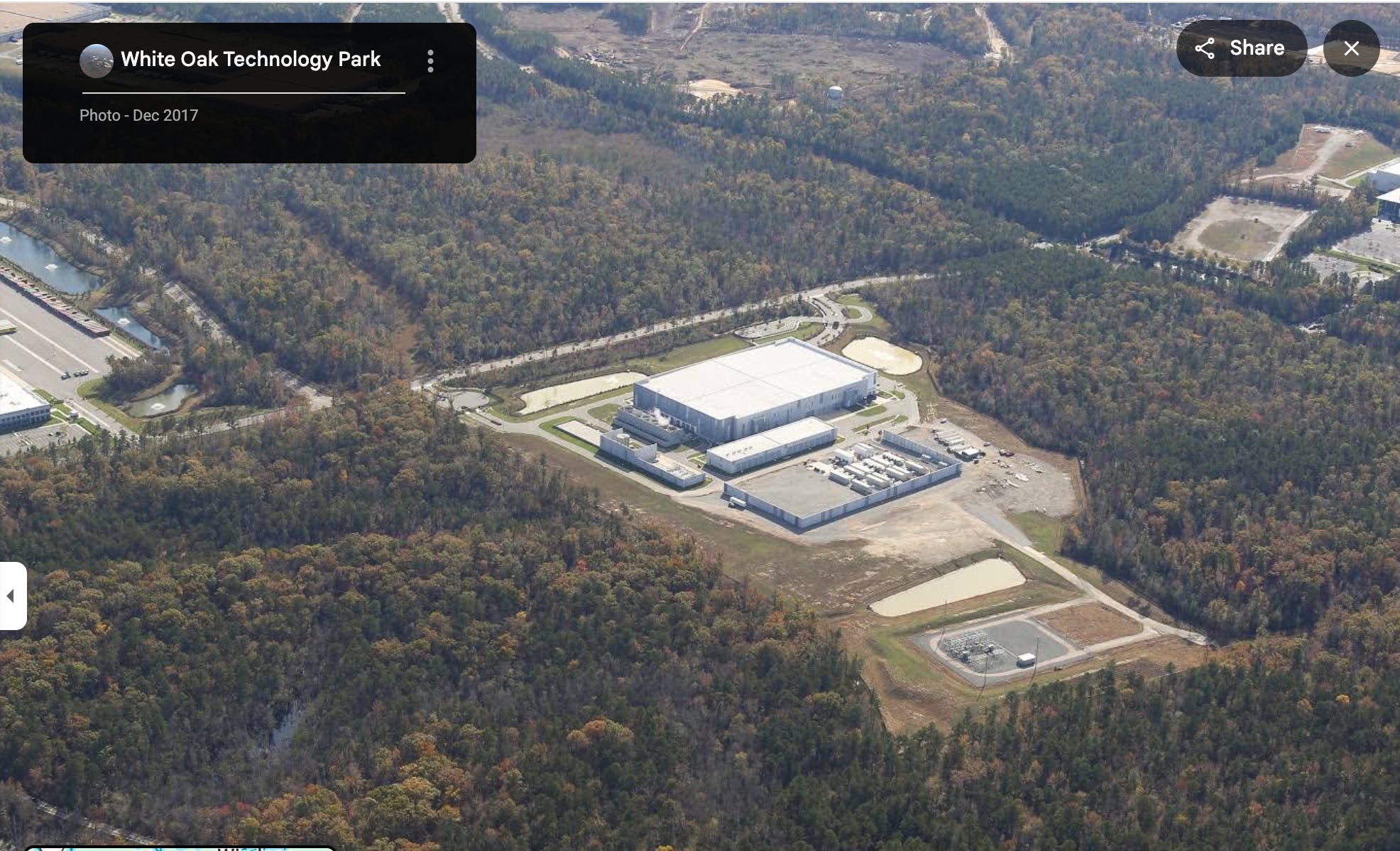
What’s interesting about the “technology park” language is that it gives the impression the area was already industrial in some way—repurposed, not created. A satellite view tells a different story. When you look at this image from Google Maps of the “technology park,” you see where the trees and natural world were cut down to make room for the “technology.”
How communities have rewritten the rules
Once officials or residents catch on, the regulatory response tends to fall into a few categories and comparing them is useful for any community trying to figure out what leverage it can use.
By right vs. conditional use vs. special exception. These are the three basic doors a project can walk through.
“By right” means a project that meets existing code requirements can proceed without a public hearing, which is fast for developers, but cuts residents out of the process entirely.
“Conditional use” and “special exception” both require a public hearing and discretionary approval from a zoning board, giving communities more say but also more work to do.
Fairfax County, Virginia, kept data centers by-right in its high-intensity industrial and commercial zones, but added guardrails. A special review is triggered above certain square footage, facilities are barred within a mile of Metro stations, and there are performance standards for noise and cooling.
Harrisonburg, Virginia, went the other direction, removing by-right permission entirely and requiring a special use permit, meaning public hearings and city council approval, for any data center in an industrial zone.
Limerick Township, Pennsylvania, used an overlay district, rules layered on top of existing zoning, to require compliance with detailed standards for noise, woodland preservation, water use, and emergency access specific to data centers.
Arizona has become its own regulatory laboratory. Chandler and Mesa both use overlay zones requiring public hearings, noise mitigation studies, and generator-testing restrictions.
The Town of Marana adopted an ordinance in December 2024 requiring hyperscale data centers to go through a full Specific Plan rezoning, including a Planning Commission hearing and final Town Council vote, with explicit standards for noise, and proof of adequate power and water supply.
Mohave County followed in December 2025 with special-use permit requirements in unincorporated industrial zones. And Tucson’s new rules, effective this September, go further still with enhanced setbacks from homes and sensitive sites, mandatory sound studies, disclosure of a facility’s energy mix including how much comes from renewables, and a requirement that undeveloped land on-site either stay as open space or be offset elsewhere at a 2-to-1 ratio.
Ready To Take Action?
Read the zoning code before a project shows up, not after. Does your jurisdiction have a data center category at all, or would a project default into “light industrial”? If there’s no category, that’s your opening to push for one, before there’s a specific applicant to fight.
Ask who’s behind an LLC or applicant name on any large industrial parcel purchase or rezoning request, especially near substations or transmission corridors.
Watch for “emergency” language on any council measure and know your state’s referendum rules and deadlines before you need them. In Ohio, for instance, that petition window is only 30 days, and an emergency designation removes it.
Push for special use or conditional use requirements rather than by-right approval, which is the single biggest determinant of whether a public hearing happens at all.
Ask for overlay-district-style specifics such as noise limits, water and energy disclosure, buffer zones, generator testing schedules, rather than a yes-or-no vote on the whole project.
Look at what other communities got in writing. Tax abatements, infrastructure money, and community benefit agreements are negotiable.
The Hard Truth
None of this action guarantees a different outcome. Ashville’s fight is still playing out, as the Ohio Supreme Court forced the village to certify the referendum petition it initially rejected, but as of this writing, the Pickaway County Board of Elections still has to decide whether the underlying resolution was a legislative act subject to referendum at all, or an administrative one that isn’t.
That distinction, buried in procedural law most residents never think about, may end up deciding whether the people in that village get to vote on an 800-megawatt gas plant a mile from their homes.
And isn’t that really the point of this whole exercise? The zoning code is boring on purpose. Reading it early is the whole ballgame.
*Special thanks to reporting by Greg Bolla on Ashville, Ohio. Check out his Substack here for more details.
Have you spotted zoning language in your own community or fought a data center rezoning yourself? Tell us about it in the comments below.
Brilliant reporting and excellent advice. Keep up the great work Erin and Suzanne!💪
Sounds like the land grabbing mafia that thrive across Asia and South America.