


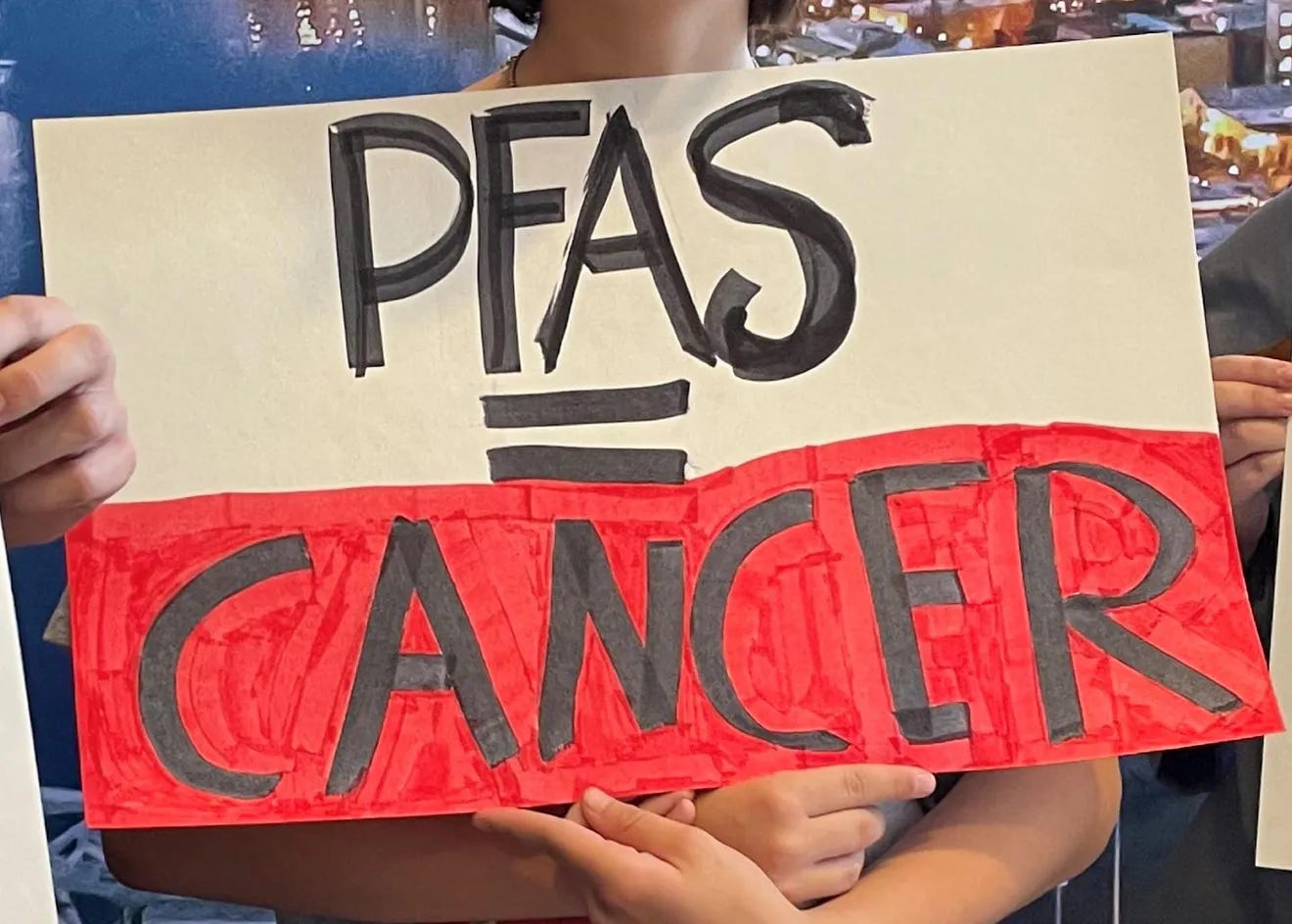
Yesterday, the U.S. EPA, the U.S. Department of Justice, and the West Virginia Department of Environmental Protection announced a $450 million settlement with Chemours for poisoning the Cape Fear, Delaware, and Ohio rivers with PFAS, in some cases without required permits, and in other cases in violation of those permits.
Some might call this kind of settlement historic, but adjusted for inflation that $450 million is worth less in real dollars than the $333 million PG&E paid in 1996. You might remember the settlement was the one turned into a movie with my name on it, and that was 30 years ago.
If you want to get more technical, the $450 million Chemours settlement includes both the $22.5 million civil penalty and the cost of injunctive relief (cleanup, clean water supply, and pollution controls). The actual cash penalty is much smaller. PG&E’s $333 million was a direct settlement payment to those impacted.
Chemours generated nearly $6 billion in revenue last year. The penalty portion of yesterday’s federal settlement, $22.5 million, is what they earn in about 36 hours.
The settlement agreement is “the latest progress delivered under the Strengthening the Long Term pillar of Chemours’ Pathway to Thrive strategy, which includes the Company's sustained efforts to address legacy PFAS and other environmental claims,” according to the company’s own press release.
It represents what Chemours has already done. What I’m watching closely is what Chemours, and the PFAS industry, plans to do next.
Now before we go any further, I want to make sure you remember Chemours.
Maybe you know it as the company that spun off from DuPont in 2015, a corporate sleight of hand that conveniently separated DuPont’s profitable specialty chemicals business from its mounting PFAS liability.
Maybe you've seen Dark Waters, the film about Rob Bilott, the lawyer who spent years fighting DuPont over PFAS contamination in West Virginia communities.
Maybe you just know the name from the headlines about the Cape Fear River in North Carolina, where Chemours' Fayetteville Works facility has contaminated more than 7,000 drinking water wells with PFAS emissions.
The AI data center boom is creating a massive new demand for PFAS. And Chemours is positioned to supply it.
Hyperscale data centers, the physical infrastructure that powers everything from Google searches to ChatGPT, are proliferating across this country at a staggering pace. Texas alone has more than 248 proposed new projects.
These facilities run hot, around the clock, and they need to be cooled. Increasingly, the industry is turning to a technology called two-phase immersion cooling, and it uses PFAS.
As we continue to cover data centers, it’s important to note that Chemours is one of the largest global producers of PFAS and one of the biggest suppliers of PFAS materials for data center coolants and semiconductor production (semiconductors are used to make the microchips deployed in data centers in vast quantities).
“The company aims to expand production of its PFAS materials, in particular resin for semiconductor manufacturing, to accommodate the growth of data centers across the country,” according to this 2026 report.
Let me say it as clearly as I can. The same company that just settled for $450 million in PFAS contamination damages is planning to make more PFAS to feed the AI boom.
It's not just the coolants. Data centers are also significant sources of PFAS through their fire suppression systems, and through the extraordinary volume of semiconductors they burn through as the industry races to build faster chips. Those discarded chips, full of PFAS, often end up in landfills.
The contamination pipeline runs from manufacturing to operation to disposal, and at every stage, communities near these facilities are at risk.
And we can’t even get straight answers on how much water these places are using, let alone their chemical footprint.
In Texas, state legislators recently learned that less than a third of data center companies responded to a survey about their water and energy use. The Texas Water Development Board has been sending mandatory water consumption surveys to data centers since 2023, and in 2025, only 17 percent responded.
The penalty for noncompliance? A $500 fine. The industry calls its operational details “trade secrets.”
Uh oh. That sounds a lot to me like the Halliburton loophole. For those that need a refresher, that loophole exempted fracking from federal regulation under the Safe Drinking Water Act.
The provision, passed by Congress as part of the Energy Policy Act of 2005, was endorsed by then-Vice President Dick Cheney, who formerly served as the CEO of Halliburton, allowed fracking companies to hide the contents of the toxic chemical solutions that they pump into the ground. Fracking fluids became protected under law, and so doctors responding to health complaints can’t access the data showing what chemicals their patients have been exposed to.
In Wisconsin, researchers at the University of Wisconsin-Milwaukee’s Center for Water Policy published a paper last year on the “hidden environmental costs” of AI data centers. Hidden, they explain, means both literally hard to obtain and deliberately obscured.
Even an academic research center with dedicated staff and institutional access struggles to get concrete numbers on how much water and electricity any particular data center is consuming.
In 2023, U.S. data centers consumed an estimated 17 billion gallons of water directly, but when you add the indirect water required to generate electricity for these facilities, that number balloons to 211 billion gallons.
If we can’t track water, the most basic, visible resource these facilities consume, what chance do we have of tracking PFAS?
The EPA’s answer, so far, has been to make it easier for the industry, not harder.
In September 2025, the U.S. EPA announced plans to fast-track the review process for chemicals used in data centers, with an explicit goal of making the U.S. the “AI capital of the world.”
The President issued an executive order directing multiple federal agencies to expedite permitting for data center materials, including coolants, semiconductors, and fire suppressants. The same EPA that just took Chemours to court for PFAS violations is simultaneously clearing a faster path for PFAS-laden data center materials to enter production and deployment.
This is the contradiction at the heart of the moment we’re in.
We know what PFAS does. We’ve known for decades, in some cases, industry knew before the public did. We have a $450 million settlement to prove it.
And yet here we are, standing at the edge of another wave of PFAS proliferation, driven by the insatiable resource demands of AI, with regulators being told to get out of the way.
I’ve spent my career watching this pattern play out.
Industry expands, corners get cut, communities are contaminated, decades pass, settlements are reached, and by then, the damage is already done. The communities around Fayetteville Works didn’t ask to have their wells poisoned. The families along the Cape Fear River didn’t consent to be part of Chemours’ production equation.
It’s been nine years since local news first started reporting that DuPont/now Chemours had been dumping unknown manmade chemicals into the Cape Fear River that couldn’t be filtered out before entering public water systems. Steps have been taken to limit human exposure to those toxic chemicals, but we are still learning about the lingering impacts of the widespread contamination on human health and the environment.
The work of cleaning up this legacy contamination and the cost to local governments and utilities dealing with the existing pollution continues.
“This deal does nothing meaningful for North Carolinians,” said North Carolina Governor Josh Stein. “This EPA, which has already weakened protections against chemicals like GenX, is now allowing polluters to pick and choose how and where they’ll fix their contamination, leaving North Carolina with no guarantees.”
The communities now living next to proposed data centers, in Texas, in Wisconsin, in Virginia, and in every state where this buildout is happening, deserve better than to be the next chapter in this story.
We need mandatory, enforceable water and chemical use reporting for data centers.
We need PFAS-free alternatives to be a prerequisite for permits and tax incentives, not an afterthought. We need the Chemours settlement to be a signal, not an exception.
Yesterday’s news is important. But the fight isn’t over. It’s just getting started.
Omg this is so frightening. Why in the h*** with the fine for a large corporation be just $500?! That needs to change. Thank you so much for breaking down these facts!
thank you so much for this. I am forwarding on to my City Council members because we are hot and heavy with data centers here in the Columbus Ohio area.