


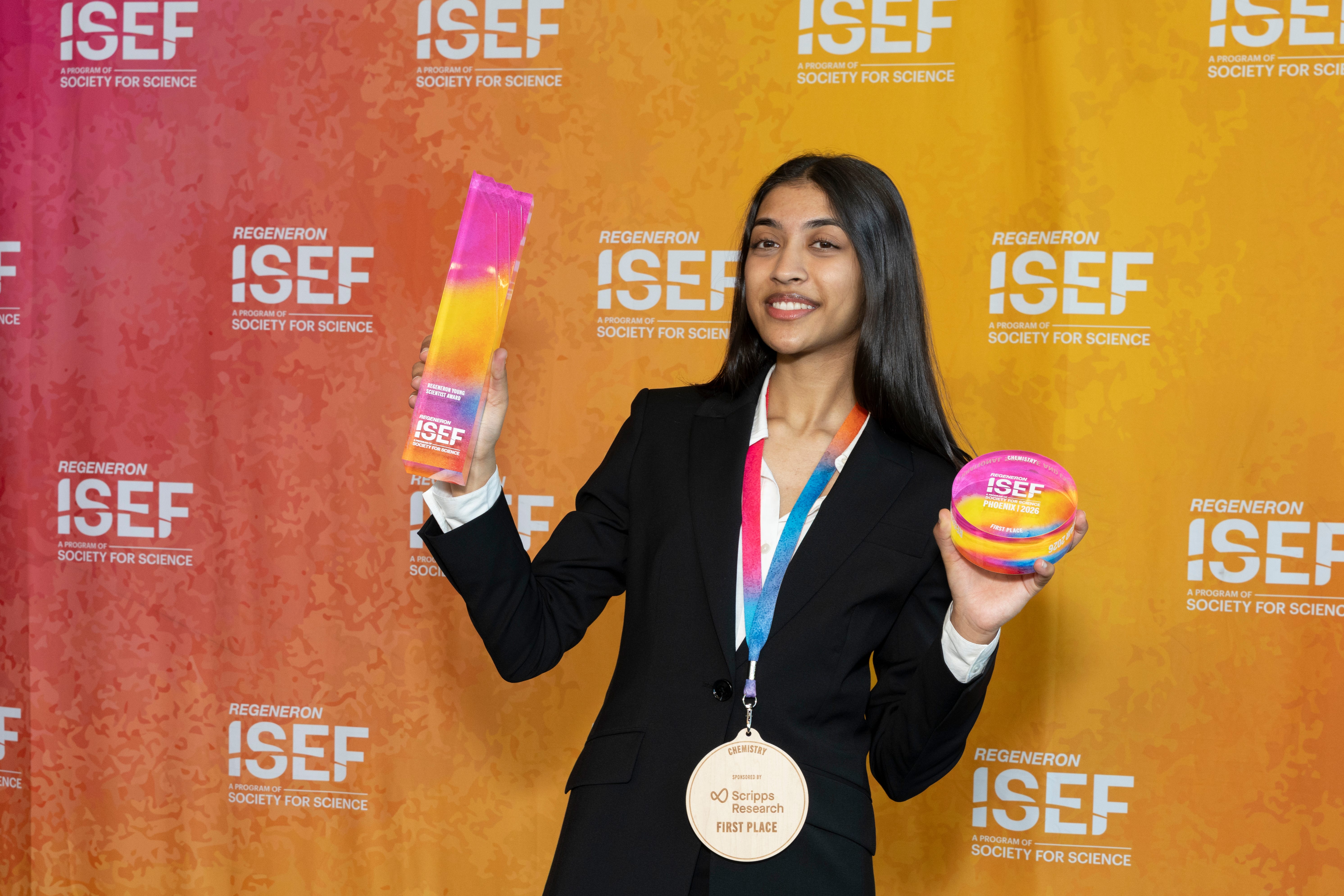
For years, scientists struggled to understand why otherwise healthy coho salmon were dying before they could spawn in streams throughout the Pacific Northwest, including waterways that feed into Puget Sound. Researchers Zhenyu Tian and others at Professor Ed Kolodziej's lab traced the deaths to an unexpected source—a toxic chemical called 6PPD-quinone, formed when a common additive in car tires breaks down and is washed from roads into waterways during rainstorms.
Inspired by this challenge, Lakshmi Agrawal looked at the NOP process used to convert bio-waste into cellulose nanofibres (also known as hydrosponges), developed by Professor Benjamin Hsiao.
The novel question she asked was: could these cellulose nanofiber hydrosponges be used to remove the toxic chemical 6PPD-quinone from water? Her novel experimental methodology showed the answer was yes.
These biodegradable sponges made from agricultural jute waste remove up to 80 percent of 6PPD-quinone from contaminated water. The material also captures heavy metals and other pollutants commonly found in stormwater runoff.
What makes Lakshmi’s work especially compelling is that it addresses a largely invisible pollution problem with real ecological consequences. Rather than simply studying the issue, she set out to create an affordable, sustainable tool that could potentially help communities and ecosystems impacted by tire-derived pollution.
Lakshmi was recognized at the 2026 Regeneron International Science and Engineering Fair (ISEF), the world’s largest international STEM research competition for high school students, where nearly 1,700 young scientists from more than 60 countries, regions, and territories showcased original research tackling some of the world’s most pressing challenges. She won $75K.
What strikes me most about her story isn’t the prize money. It’s what she said when I asked about what gives her hope for the future. She talked about how we need to listen to one another and the collaborative nature of science.
In fact, her own efforts were truly collaborative. She organized between the two labs across the east and the west coast, designed and coordinated the experiments, arranged for the preparation and shipment of samples, and is currently working on a research paper.
She is one of several young environmental innovators emerging from this year’s competition. In addition to Lakshmi’s work on tire-derived pollutants, other award-winning students developed technologies to improve plastic recycling, protect pollinators without traditional pesticides and monitor water quality through novel approaches to environmental sensing.
I thought Lakshmi’s story might resonate with all of you too. If a young scientist can learn about pollution in her own backyard, study an emerging contaminant, and become a problem-solver, I know each one of us can make a difference using our unique gifts as well.
Q: What sparked your love for science and your excitement for environmental science?
Lakshmi: Duringthe summer after 8th grade, I volunteered as a Nature Camp Counselor at Islandwood. On one particularly hot summer day, I brought my group down to the lake to observe aquatic species.
It was then that I noticed an oil sheen on the surface of a pond, and I remember just standing there, wondering how that would affect all the various aquatic organisms that relied on this natural ecosystem.
How would the water striders walk across the surface of water? What was actually happening chemically? Would that understanding help keep the water safe for all the ecosystems and communities around the lake?
I was curious, so I went home and started experimenting. Initially, I was simply trying to track surface tension and evaporation rates.
However, I then started adding variables and studied the correlation of the critical micelle concentration in terms of evaporation and surface tension.
Since then, every project has started off from a small and visible problem, that’s turned into a 007-esque chase for an explanation: Bellevue City Council water reports highlighting near-EPA limit levels of trihalomethanes and haloacetic acids or 6PPD-quinone killing coho salmon in the PNW region.
Discovering solutions to my community’s problems also addresses the global issue of how we protect our planet’s freshwater.
Q: Tire pollution is largely invisible to most people. How do you think we can get more people to care about toxins they can’t see?
Lakshmi: The hardest part about conducting scientific research is convincing people to care enough about your work to understand its importance. Using statistics, facts,
and ultimately logos doesn’t pull on heartstrings.
Almost nobody can picture 6PPD ozonating to form 6PPD-quinone, but almost everyone can picture a dying coho salmon in a stream, or picture that their own driving puts something into the water they can’t undo.
So, a lot of my outreach, presentations at the American Chemical Society and the American Water Works Association, talking to my local council about environmental protections, founding my school’s Science Research Club, has been about effective scientific communication that transforms invisible chemistry into a story that people can relate to and care about: salmon, drinking water, the orcas that depend on salmon, the communities whose livelihoods depend on a $1.5 billion fishing industry.
Faced with existential crises, such as climate change, I genuinely believe that the bottleneck isn’t a lack of concern, but rather, a lack of understanding.
Q: You developed a biodegradable sponge made from agricultural jute waste. Tell us more about how you discovered this solution and how it works.
Lakshmi: Since January 2025, I’d been learning about how 6PPD, a tire antioxidant, reacts with ground-level ozone to form 6PPD-quinone, which kills coho salmon before they can spawn. I couldn’t stop thinking about removing it after the fact, since
reformulating every tire in the world isn’t realistic on a short-time scale.
That question followed me into my Simons Research Fellowship at Stony Brook, where I read through an immense quantity of literature and kept coming back to cellulose nanofiber hydrosponges, a material Professor Hsiao’s lab makes from jute fibers through a patented, zero-waste nitro-oxidation process.
Nobody had ever tested them against tire-derived pollutants. I proposed connecting the two labs and have worked on the project ever since.
The “how it works” part comes down to surface chemistry. Jute-derived cellulose nanofibers (CNF), made via a zero-waste nitro-oxidation process that leaves them carboxyl-rich and negatively charged, have huge surface area and tunable porosity. I cross linked them with aluminum and citric acid to compare two binding chemistries: citric acid adds extra carboxyl groups for electrostatic capture, while aluminum binds through metal coordination.
Both create a pore network that grabs contaminants two ways at once: physically trapping tire wear particles, and chemically binding dissolved 6PPD/6PPD-quinone to the CNF surface.
Since the whole process starts from jute agricultural waste and stays cellulose-based, the sponge itself is biodegradable, so the cleanup material doesn’t become another pollution problem.
Q: You won $75,000 at Regeneron ISEF. What’s next for your research and this project?
Lakshmi: I’m back at Stony Brook at the moment to finish up this project! We have a few more tests to run before the paper’s ready to publish.
As a technology, the applicability of hydrosponges is expansive: the same adsorption mechanism can be applied to other tire-derived contaminants like benzothiazole and DPG, and PFAS and microplastics down the line.
For me personally, this is the project that’s taking me into a chemistry/chemical engineering degree at MIT, and I want to keep building toward a PhD in chemical or environmental engineering. I see this award as a stepping stone to a bigger, more impactful career.
Q: What gives you hope for the future?
Lakshmi: The collaborative nature of science. People often view science as an elitist sport, where the only competitors are intellectual PhDs in lab coats.
However, science is about curiosity, not credentials. The 6PPD-quinone problem was first brought to light thanks to citizen scientists around Seattle who observed dead coho salmon.
What gives me hope for the future is the larger integration of interdisciplinary fields working together to effectuate theoretical ideas into deployable solutions.
Ultimately, the better we listen to each other, the better we collaborate.
I’m so inspired by Lakshmi’s work. Her story really speaks to how one person can take something they are curious about in their backyard and make an impact.
Thank goodness we have bright young people trying to clean up the mess their elders have left behind.
My granddaughter, Aubrey, designed and built a robot that won the county, won the state and was invited to Legoland in California to compete against the world. She won first place. She was 11 years old.