


Forget about Monday Night Football. We’re now in the season of Monday Night City Council Meetings.
Contentious city council meetings are happening across the country where residents are finding out that key decisions about AI Data Centers were often made before they showed up.
Community members in Clinton, Iowa; Ferguson, Missouri; and Granbury, Texas, (and many, many other places) have been filling chambers, gathering signatures, and showing up.
This is what democracy looks like!
But they are also discovering how local power works for and against the people.
Clinton, Iowa. Population: 23,965
Proposed Data Center: QTS
The project began as a rumor. It turned into a council fight by late spring when the council chamber was packed with residents demanding a moratorium on data centers.
Many asked the big question: Why they were only now hearing about it?
QTS’s website says they are in the “very early stages of planning.” The site sits between Clinton Municipal Airport, Valley Oaks and a residential neighborhood.
In June, the council voted 5-2 against a moratorium. Council members argued that a moratorium wouldn’t change much.
Councilman Cody Seeley said a moratorium signals the city is “closed for business.” The city later said the vote wasn’t an approval of anything, and that QTS has not submitted a development plan.
With no moratorium, the city moved to write rules. City Attorney Patrick O’Connell drafted a 15-page ordinance and presented it at a July Plan Commission hearing. He said no developer was consulted.
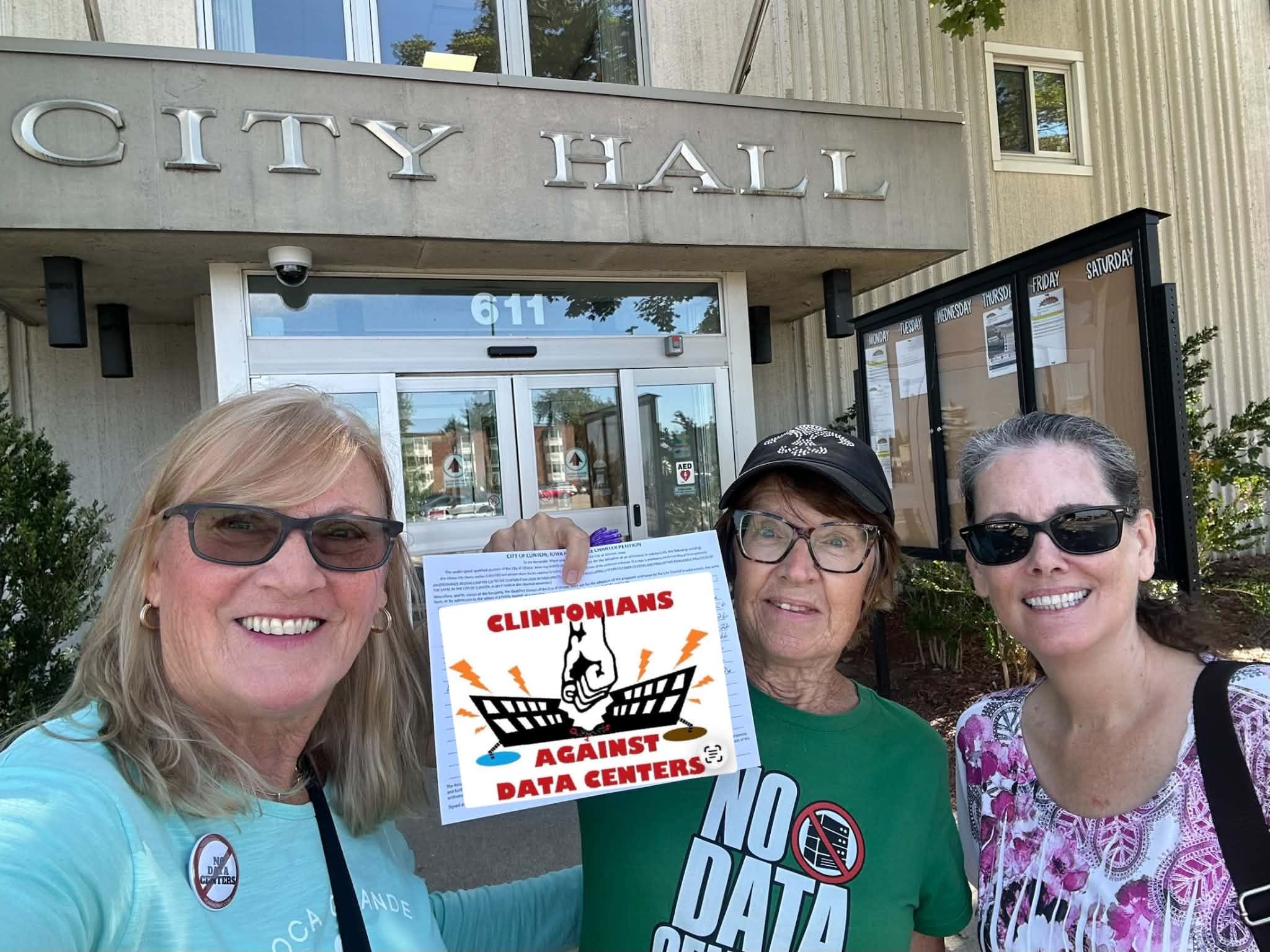
Clintonians Against Data Centers responded by having members write their own ordinance. Organizers said on the record that they “will not accept” the one the city wrote “in haste.” Then came the petition.
The fastest ever successful petition in Clinton history? That’s according to CADC Steering Committee member Celeste Robbins, who has had experience with other petition drives.
The grassroots group submitted a petition containing more than 1,500 signatures from registered Clinton voters to their City Hall on Monday. The petition was delivered to the City Clerk’s office.
The signatures were collected in the past two weeks. Residents organized around concerns regarding the proposed development and regulation of a hyperscale data center in Clinton.
“Through our petition process, we have met countless neighbors and fellow citizens who want their voice heard,” Celeste Robbins said. “Every signature is a reflection of a choice by a resident to say they want their community protected, that safety is more important than the money. We hope our City leadership will recognize this. It has been an uphill battle, but every Clintonian should take pride in what our group is bringing in today.”
The proposed ordinance seeks to establish definitions and restrictions concerning data centers and hyperscale data centers and prohibit dangerous practices of hyperscale data centers in Clinton.
The purpose of the proposed ordinance is to prohibit activities associated with data centers that it states could pose risks to nearby residents and the environment. The proposal identifies concerns involving health, quality of life, financial stability, historic, geological and archaeological areas, natural habitats, and wetlands.
CADC members have been concerned since the City Council deleted livestock grazing areas from the data center ordinance sensitive receptor definition.
The petition clearly lays out sensitive receptors as “schools, preschools, day care centers, in-home daycares, health facilities such as hospitals, long term care facilities, retirement and nursing homes, community centers, places of worship, playgrounds, parks (excluding trails), campgrounds, prisons, dormitories, livestock grazing and housing areas, and any residence.”
The petition submission came on the same day the Clinton City Council was scheduled to continue discussions concerning the data center ordinance.
Ferguson, Missouri. Population: 17,837
Proposed Data Center: Project Butterfly
The meeting lasted more than three hours. The vote came after months of debate. The results were disappointing for many residents.
The Ferguson City Council voted 4-3 on September 22, to approve a redevelopment of the 217-acre former Emerson campus, after a tense meeting where residents spoke out against it.
The deal gives the developer up to $1.5 billion in tax incentives and let the city issue up to $22 billion in industrial revenue bonds. The campus is run by Next Revolution Technologies. It already has a smaller data center, and the proposal includes a potential expansion to 300 megawatts, which would draw as much power as a small city.
The vote was the second try. In May, a 3-3 tie halted an earlier version, with the mayor casting the deciding no. Opposition then included the St. Louis County NAACP, the Ferguson Library District, and the Ferguson-Florissant School District.
Four months later, two council members reintroduced the plan. One argued it would fix the city’s budget problems, after the city cut 12 jobs this year. The new version added $7.5 million over 10 years to a neighborhood nonprofit, $700,000 for the city, and a $250,000 environmental mitigation fund (which seems slim). The nonprofit has ties to multiple council members, according to reporting in St. Louis Magazine.
Community members have many concerns about this project, regardless of the vote. They cite utility bills, environmental impact, and what they see as a lack of transparency from their elected leaders.
One resident who reached out to me says the public still doesn’t know the project’s maximum size, what generation equipment will be installed, how much water it will use, what it will emit, or who pays for the infrastructure. She also noted that key protections in the agreement use discretionary language like “reasonable efforts” rather than enforceable requirements.
Opponents say they will keep fighting and are exploring legal options.
Granbury, Texas. Population: 13,740
Data Center: Project Patriot
Another council meeting, another walkout.
Residents stormed out of a special Granbury City Council meeting Monday night after public comment. One resident called the meeting a “circus.”
The project in question is being developed by Bilateral Energy, which has plans for a self-sufficient data center campus with on-site power generation and privately funded infrastructure, according to their website.
The council annexed about 2,090 acres in January and rezoned the tract for industrial use in April, a designation that allows power plants and data centers. In 2025, the Texas Commission on Environmental Quality issued an air permit for turbines and generators at the center of the property.
City officials argue that a concept is not an approval. They say they have received no development application and signed off on no site plan.
But community members say they were kept in the dark. Opponents say city leaders weren’t upfront about industrial plans for the land before voting to annex and rezone it. So, they asked for a recall.
Organizers say they collected up to 1,470 signatures on each petition. The city charter requires signatures from 15 percent of qualified voters, which organizers estimated to be near 1,300. That threshold is based on the voter rolls, not the city's population of about 10,800. The city, however, has said few of the signatures could be verified and that the charges weren’t specific enough.
After residents went to court, the city said in late August that the petitions would go to the council. Organizers want a November ballot, but the city says the earliest recall election would be in May.
City Mayor Jim Jarratt told attendees at Monday’s meeting, “I will not resign.”
“They tend to do this,” community member Rachael Jacobson told Fox 4. “We speak, they don’t hear what we’re saying. Maybe they hear it, but they don’t hear what we’re saying—and then the rest of this show goes on and they just do whatever they want.”
The meeting did reconvene later, peacefully.
When local officials move forward without the voices of their constituents, we’re heading in the wrong direction.
People deserve transparency and a seat at the table for the future of their community.
Keep up the good fight, folks!
Have you been to a contentious city council meeting about an AI data center coming to your area? Tell us about it in the comments below!
Look up Project Nimbus & Tel Aviv. Rep 219- Palantir & USDA Ag- Project Matador-FERMI-Amarillo by Morning-Military Tech being installed in Big Ag. Control Grid & Track & trace. Cattle ranching is being turned into a #Utility.
People need to get their representatives to think ahead...and not focus on the money. Our government has not and does not put people first. Its all about the money-producing industries. ...Our representatives are supposed to be guided by the input of the voters; the ones who put them in office. The people don't want to see more land turned into desert without the water there communities need. There are many other negative issues that will harm the people. These Data Centers are financed by investors who are focused on the massive profit they will make...not the people or environment they will harm.