


Regulatory agencies failing to hold polluters accountable is nothing new. Yet, this permit fight stands out because the state’s own record says the feedlots are more than likely the source of pollution.
In Larned, Kansas, with a population of a little more than 6,000 people, two cattle feedlots have operated for more than 40 years over a shallow, sandy aquifer.
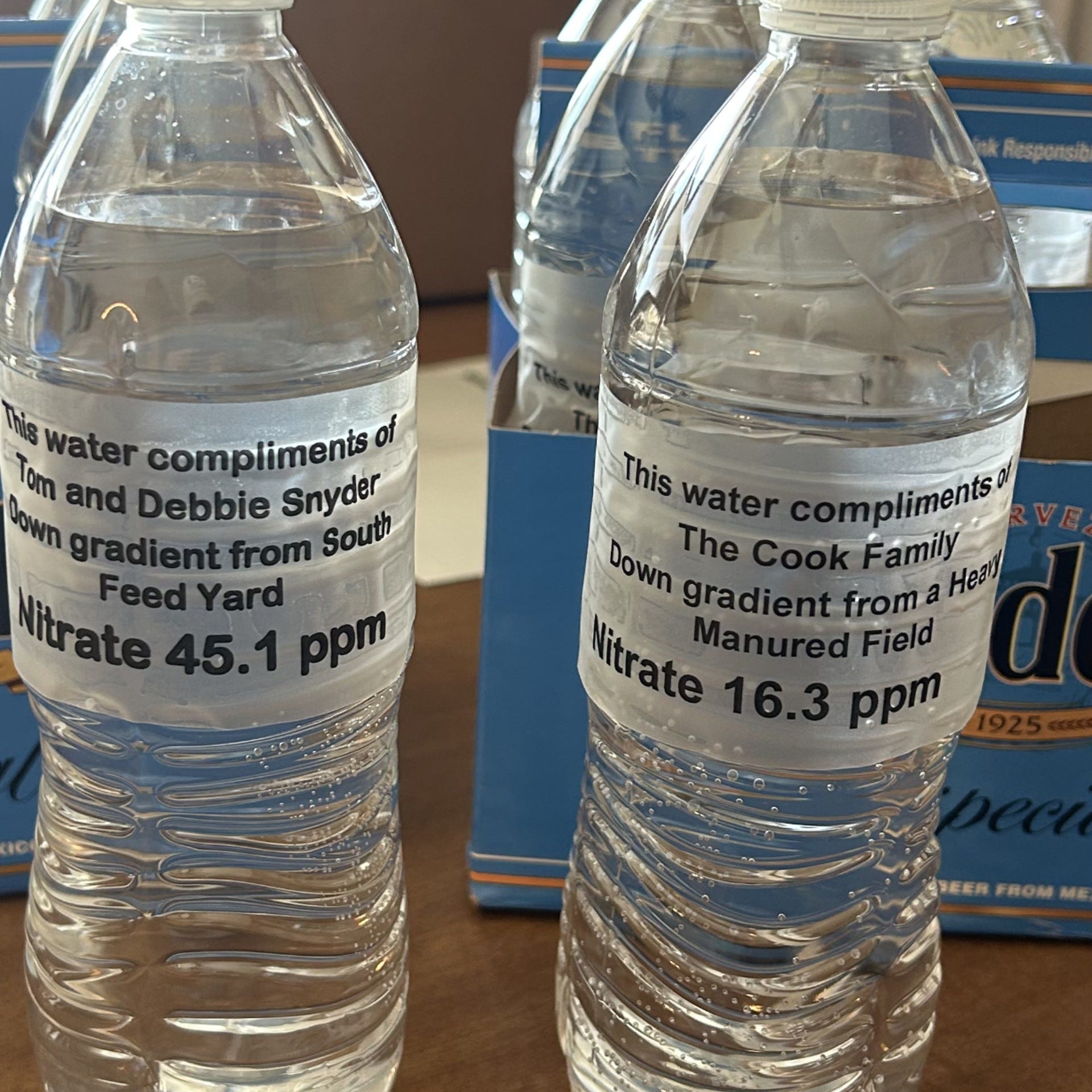
Groundwater monitoring at the sites goes back to 2001 at one and 2012 at the other, and the record is remarkably consistent: nitrate levels above the federal drinking water limit of 10 mg/L at nearly every well.
Nitrate levels in the groundwater below one of the existing ILS feedlots have measured as much as six times the EPA’s safe drinking water standard. High nitrate levels have been linked to higher risk of colorectal cancer.
The area has 204 private domestic wells within four miles, providing water for nearly 500 residents. This small rural county has no other options for drinking water.
In case you’re not familiar: A feedlot is a confined animal feeding operation (CAFO) where cattle are housed, fed, and managed in concentrated feeding facilities to rapidly gain weight, finish for market, or prepare for slaughter.
Longtime Larned residents turned activist-citizen scientists Merrill Cauble and Felix Revello have been worked tirelessly to protect their community from the impacts related to Innovative Livestock Services feedlots, including a new one. Their story is compelling and unfortunately all too common.
They helped form Pawnee Citizens Advocating for Rural Environment and Economy, an advocacy group, mobilizing residents to raise their concerns to the Kansas Department of Health and Environment (KDHE).
As the industrialization of our rural lands takes hold across this country, an opportunity to highlight what passes for “regulation” in Kansas is a cautionary tale for all the pushback happening from data centers to factory farms.
“One citizen acting alone is not effective but many acting together with one voice can overcome obstacles that a single individual cannot.”
Q: Can you talk about Pawnee County. What’s it like, and what’s changed there during the years you’ve lived there?
Merrill and Felix: Pawnee County is largely a rural agricultural community of family farms and ranches. The landscape is typical of our region with widely scattered homesteads in a landscape generally dominated by row crop agriculture of wheat, soybeans and corn. Other “major” industries are the state mental health hospital and a Department of Corrections facility.
Also typical of rural communities are vignettes of abandoned farmsteads resulting from continuing consolidation within the agricultural economy and community… consolidation caused by misguided government programs favoring industrial agriculture and collusion between feedlots and packers. The land is becoming more vacant of farm families as people have left the land, forced off by economic forces beyond their control.
Visual changes over the years includes the increasingly abandoned landscape and streams withered by hundreds of irrigation pivots withdrawing water in unsustainable quantities. For example, the once perineal Pawnee River where boating and fishing were common up into the late 1970s is now an intermittent stream with a deep muddy bed. The other notable development is the consolidation of land into ownership by a single feedlot operation that outbids ordinary family operations just about any time land comes to market in that area. The count plat map clearly shows the results.
Q: Merrill, you grew up in the cattle industry yourself. How has the farming landscape around Larned changed as smaller operations have given way to large-scale feedlots?
Merrill: In the early days, ranchers and farmers grazed their cattle on their pastures and wheat fields. This grazing system has been replaced by anti-competitive collusion between mega-feedlots and packers violating anti-trust laws with impunity.
Essentially, generations of family farmers have been erased from the rural landscape by industrialized agriculture taking the profits from rural communities and leaving behind only pollution and poverty.
Q: You requested the public hearing back in January 2025, which in Kansas isn’t automatic, a resident has to ask for it. What made you decide to push for that hearing, and what did you hope would come out of it?
Merrill and Felix: We were partners in this endeavor from the outset so we both campaigned for the public hearing. He and I decided that we must mobilize citizens to fight for their environment and rural economy. It wasn’t just us demanding the hearing.
We held a town hall in March to inform and encourage citizens to take action. It was their concerted will through letters to KDHE demanding the hearing that made the difference. One citizen acting alone is not effective but many acting together with one voice can overcome obstacles that a single individual cannot. Our hopes were to prevent another feedlot from coming in to Pawnee County to avoid creating even more of the same air and water pollution our rural residents were and still are suffering from.
Q: At what point did you go from noticing a problem to actively collecting water samples and getting them tested? What did that process look like?
Merrill and Felix: We initiated water sampling soon after we began the fight. We figured “citizen science” was key to obtaining information to determine how serious related water pollution is and mobilize county residents.
It was obvious county leaders and the KDHE did not want to know the extent of pollution… that they would not have to respond to pollution if they could claim that it is unproven; a tactic commonly used by elected and government official who want to pretend that there isn’t a problem because it would require them to act.
We also understood that test results are evidence that should move elected officials and government agencies to take effective action but were not so naïve to believe 100 percent that they would, which they didn’t, despite having powerful statutory to demand KDHE to conduct an effective study and remediate any pollution found.
This failure of county commissioners to protect the health of our residents is especially disappointing and, frankly, disgusting. And, just as importantly, the test results are needed to inform and arouse citizens to demand more scientific investigation and remediation of pollution as found.
Q: You obtained a letter where an EPA site assessment manager told KDHE that both feedlots likely had releases from their wastewater ponds. How did that document change what you understood about what regulators knew?
Merrill and Felix: We had no idea that EPA had warned KDHE. It will be helpful if we decide to litigate the issue. That letter provided more documentation that KDHE knew about the issue.
However, we had already discovered through Kansas Open Records Requests by a CAFO specialist from the Kansas Chapter of the Sierra Club had spent more than two decades documenting their ineffective attempts to stop pollution at the feedlots, mainly because they lack the will to take effective action.
We do not fault KDHE employees for not doing the job they should. Their greatest obstacle to effectively enforcing environmental regulations is pressure applied to them by high-ranking officials complying with instructions from certain politically powerful Kansas livestock associations. We believe that this extends all the way to the Governor’s office and Kansas Department of Agriculture Secretary Mike Beam.
Q: KDHE’s own remediation bureau said the site “appears to be a source of nitrate groundwater contamination,” and then the agency renewed both permits with no new corrective requirements. What was your reaction when you learned that?
Merrill and Felix: Many folks would think that we would be astounded but we were absolutely not surprised in any way. They used many of the same old standard spurious arguments that we have seen many times during this fight. Actually, some of their assertions are, tragically, laughable, especially coming from people who we know are intelligent and generally wanting to protect Kansans’ health.
Q: About 500 people rely on this aquifer and about 204 private wells with no alternative water source. What are you hearing from neighbors dealing with nitrates in their tap water? What actions are they taking, and what can they afford to do?
Felix and Merrill: These folks are disgusted, sad and disappointed in County Commissioners, feedlot management and State government. Many of these folks have resorted to expensive reverse osmosis systems.
Q: With the CERCLA site evaluation still open even after the permits were renewed, what are you watching for next, and what would it actually take to change the outcome here?
Felix and Merrill: Supposing you are referring to the Site Evaluation recommended in the Preliminary Assessment, it has been completed for several weeks, definitely more than a month but KDHE will not release it. We are waiting for them to respond to my KORA requesting the document. Oh, they said that they received my KORA but still have not sent the document. When government responds that way, it arouses suspicion that they are hiding information they don’t want the public to have.
Q: What advice do you have for other communities that are just starting to deal with nitrate pollution or feedlot fights of their own?
Felix and Merrill: Be tenacious, get information, document your efforts, get officials on the record, use every available legal and statutory authority, use facts to force officials to act even if nothing more than to demonstrate their refusal to do their job, provide citizens with science-based information.
Remember, “You aren’t whupped as long as you’re still fighting.”
Keep the conversation going in the comments below. What passes for regulations in your state? What pollutants are you working to keep out of your aquifer?
Thank you Erin. You’re a treasure. This was wonderful.