


It’s so easy when covering hyperscale data centers to report on concrete and servers. Or cooling systems, megawatts, and zoning maps. It’s hard to picture the families it impacts or the backyards that get caught in the middle of an industry’s growth.
Today’s guest essay is from Madison Taggart, whose family is facing exactly that. A 185-foot power line is set to cut through the Virginia woods she grew up in.
What follows is a story about power lines, but it’s also a story about what a childhood home is worth, and what happens when it stands in the way of an industry that grew faster than anyone planned for. I’ll let Madison take it from here.
My backyard has always felt like a timeless space. Our house is at the end of a cul-de-sac in Loudoun Valley Estates, overlooking the forested hills of the Broad Run River Valley ringing around the back of the community. I could walk to my old high school from the property, if I was willing to get my shoes wet.
I know my backyard from the tall rolling hill where a birdfeeder currently sits, the sheer cliff decked in cedars, sycamore, and dogwood and yet more native brush plunging toward the stream, where lines of rocks I made with my father when I was younger make the river burble.
In the winter, the hill is perfect for sledding. In springtime, rains flood the stream and bluebells arise around the floodplain. My grandmother’s garden still stands as a living reminder of her puttering out to tend to the chives. Further back in the woods is a place named Picnic Park on Google Maps, where my dad has put down picnic tables, and is home to the high-school cross country team’s trails.
My parent’s home is the place we could run away to when the weight of modern life was heavy. But since 2025, the backyard is no longer just green space. It’s the stage of a legal and industrial war we had been blissfully oblivious to until a phone call changed everything in 2025.
The “call from hell” as my mom calls it came on a Friday the 13th. I was not home for the call, but I was there for the aftermath when my mom gave me the news, seething in anger and dread. Dominion Energy, our power company, asked if they could walk our property for an “alternative” Golden to Mars high-voltage power line called Route 3A.
We had heard of Golden to Mars. Our community had already been fighting another route following Loudoun County Parkway directly in front of us, listed as Route 5 in their plans. We previously learned they planned to have nine underground options alongside five aboveground options with an open house to weigh them.
Route 3A was different. It arrived with no public meeting and no advance notice. Until that call, none of us had known it existed.
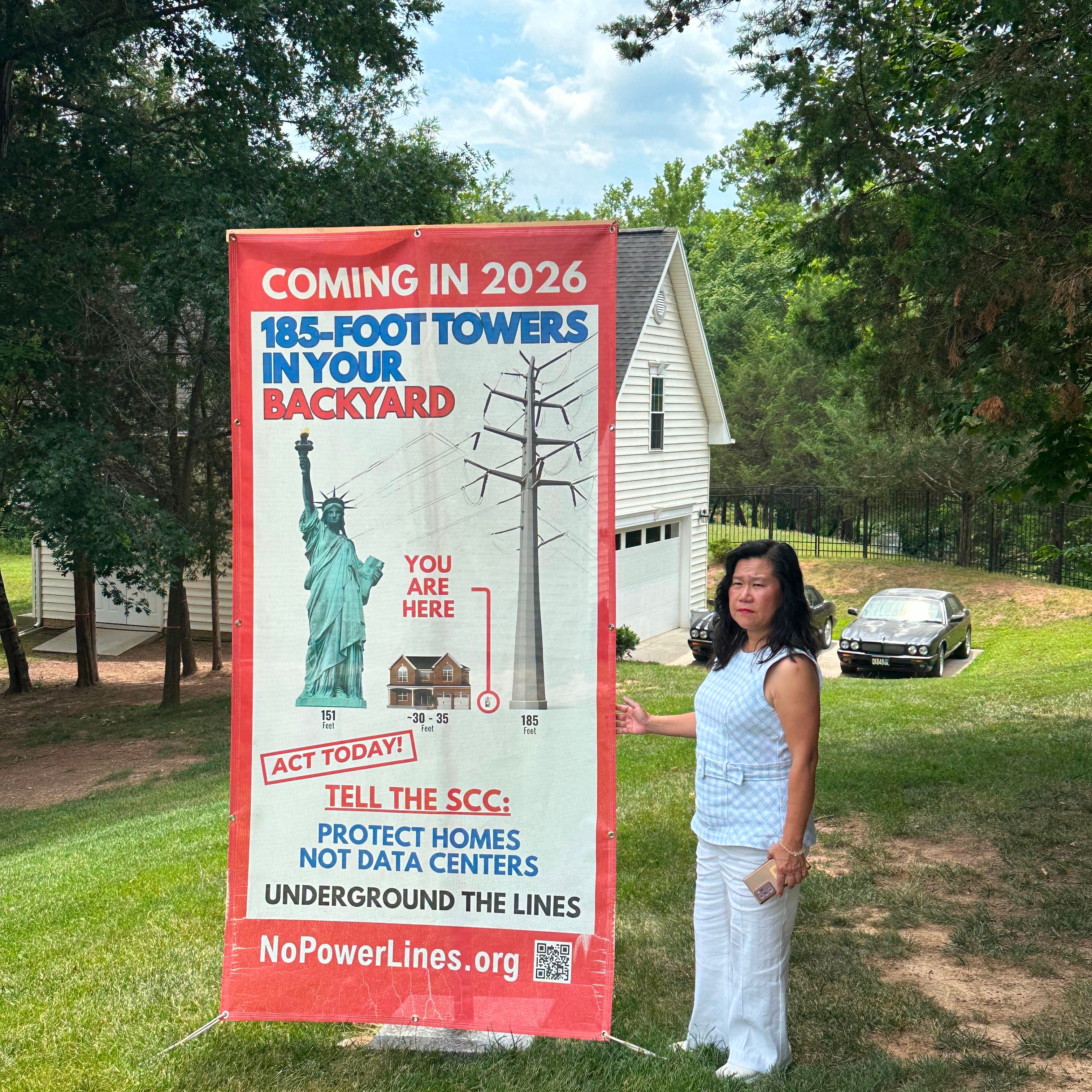
Every part of this line is destructive.
It includes a 185-foot power pole, taller than most 15-story buildings and the Statue of Liberty, planted in the middle of our backyard. It calls for 500-kilovolt lines, a voltage typically found only near nuclear plants, running less than 100 feet from our neighbors’ windows. It cuts through miles of forested old-growth trees in the Broad Run River Valley, a corridor conservationists have flagged for its wildlife habitat and water quality. A total of 182 homes sit just 500 feet of Route 3A. We are not an isolated backyard. We are one of 182 homes—and that is just “direct” impacts.
All this destruction is to power data centers in Ashburn, Virginia, known by many as “Data Center Alley.”
That phone call was the start of our education into data centers and high-voltage power lines, a crash course we never asked to enroll in.
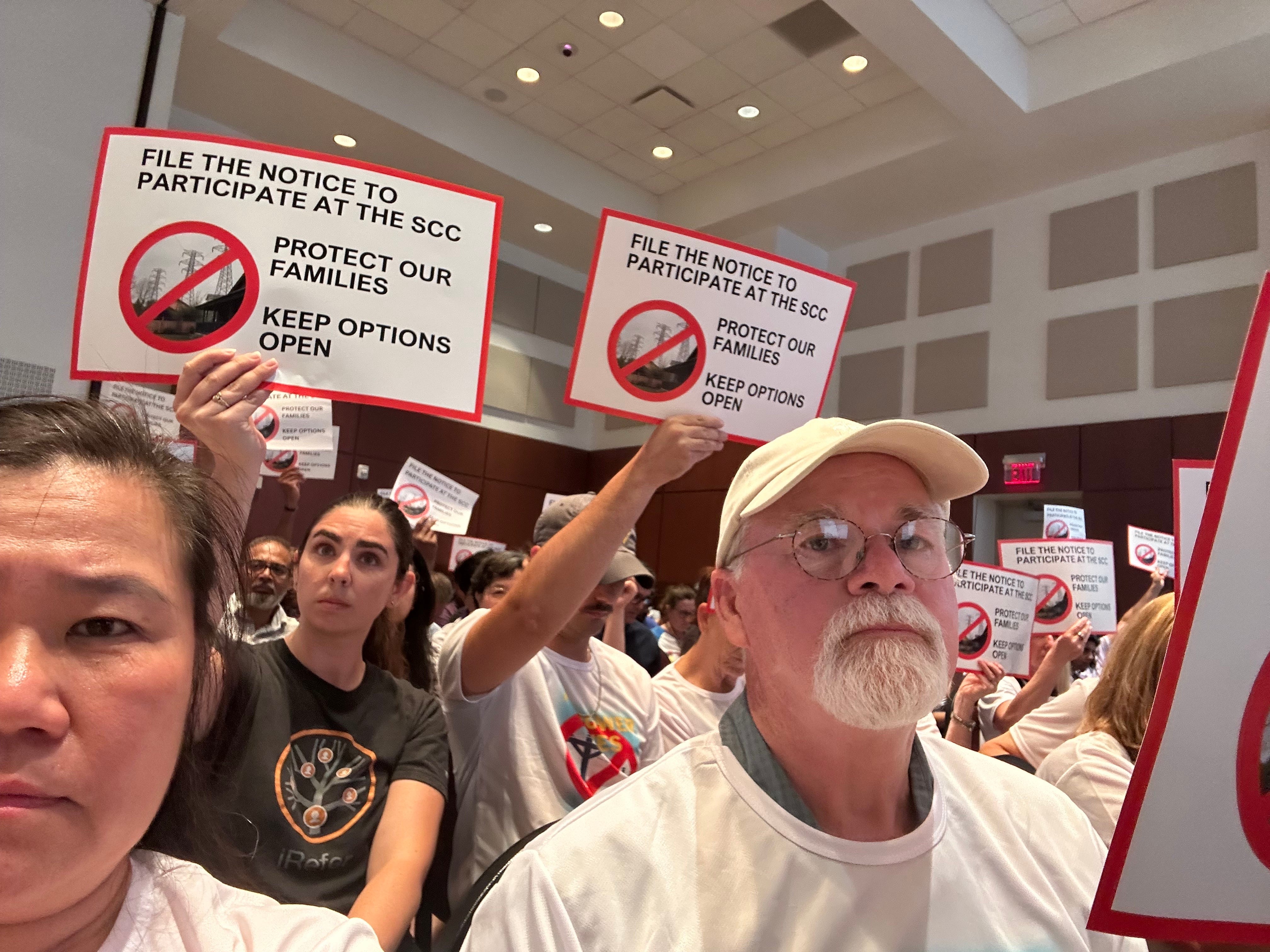
Our year has been filled with correspondence, research, and flooding the Virginia State Corporate Commission (SCC) in their website and their hearings with neighbors pleading to pick anything but these aboveground routes.
It has been a long grind, and it isn’t over.
As of June 29, the SCC issued its final order, deciding that Route 3A is the “best” route for the Golden to Mars project. In the order the commission says Route 3A is “clearly inferior” to the alternative route by “almost every objective measure,” as it is longer, costlier, and closer to more homes. They approved it anyway, citing an “urgent” need to keep the region’s power reliable.
Despite feeling disheartened, our community has chosen to continue resisting the order, and pushing for reconsideration, even if it means going to the Supreme Court of Virginia.
Hours after the order came down, the Loudoun County Board of Supervisors passed a resolution demanding the route be reconsidered before July 20, the date the SCC loses jurisdiction and the order becomes permanent.
And in a move county officials are calling extraordinary, our HOA deeded 12 acres of land, directly to the Loudoun County School Board, hoping to hand the board the same leverage over Route 3A that it had used to block the commission’s preferred route months earlier.
As I write this, the School Board hasn’t officially decided whether to use it. We have until July 20 to find out.
So how did we get here?
Gem Bingol, a land use field representative with the Piedmont Environmental Council, has watched this unfold for two decades.
Ashburn became a data center magnet, she told me, because of Loudoun’s hunger for tax revenue, its friendly land-use rules, its proximity to Washington D.C., and a reliable grid to plug into.
“Initially, when data centers were approved, they were all within Data Center Alley, and there wasn’t much to pay attention to,” she said of the industry’s early years. The thinking then was simple; it’s all inside the building.
That thinking hasn’t aged well. PJM Interconnection, the regional grid operator responsible for planning power supply across Virginia and 12 other states, has its own long-term forecasts that show how badly the industry underestimated itself.
In 2022, PJM projected the Dominion zone, which covers Loudoun and the rest of Data Center Alley, would add about 5,700 megawatts of new load by 2037. Three years later, in 2025, that same forecast for the same year had quadrupled to more than 20,000 megawatts. Summer peak demand in the Dominion zone hit 23,905 megawatts in 2025 alone, which is 23 percent higher than in 2019.
The industry didn’t plan for its own growth and is now building through our woods to catch up.
My family drove past those data centers hundreds of times without a second thought. I noticed the trees coming down for gray concrete blocks but figured we all need somewhere to store our digital lives. Painted in muted reds and blues, ringed by shrubs and black fencing, they were built to look almost harmless. Almost.
Despite looking like office parks, data centers carry industrial power demands that rival heavy manufacturing, and the grid built to serve them is now cutting through neighborhoods, not just the alley that gave it its name.
Now that lack of planning is manifesting in power lines ripping through the community in the name of data centers.
By far one of the most crippling consequences of having so many data centers in the area is the sheer power demand, which takes us to Dominion Energy and how eminent domain laws have become their best weapon.
Dominion Energy has for years now been leveraging legal loopholes in eminent domain law and their own power in the government to get their projects through.
Data centers are private businesses, but the transmission lines built to power them aren’t treated that way. Under Virginia law, Dominion only needs the SCC to certify that a line serves “public convenience and necessity,” not that the data center itself benefits the public, and that certification alone hands Dominion the legal power to take private land through eminent domain.
We’ve also learned that Dominion operates by splitting communities apart. Once the application was filed, the utility layered on so many aboveground route options that different pockets of the neighborhood, and the school board, were pushed into arguing over whose yard should be sacrificed, rather than uniting against the project itself.
Dominion’s public materials leaned hard on the number of homes affected and the cost of each option, which became their main argument against burying the line. The only way we found the fuller picture was for our community to band together and dig for that information ourselves—asking questions during open houses and reaching out to people who’ve already been fighting the power lines and data center’s unregulated growth.
As we’ve fought, I’ve seen two main camps of advocates emerge.
There are people like my mom, who are always proactive and throw themselves into fighting against the power lines in collaboration with people like Gem who know more about the far-reaching issues of the power line. My mom has lost sleep as she’s spent almost every day emailing journalists to spread awareness of our fight, rallying support in our community, setting up websites and funding, and gearing for what is inevitably going to be a prolonged fight.
On the other end of the spectrum, my dad has fallen into cynicism. They still help when asked, but our progress to him seems minimal, and he seems convinced that the power line will go through. And it’s hard not to blame him. Data centers and their corporate and governmental backers wield a lot of financial and legal weight.
But this work is far from hopeless.
We’ve found organizations like the Piedmont Environmental Council, who have been generous with their resources and knowledge. Even inside a system stacked toward development, we’ve found lawmakers who recognize the problems with the system and are willing to work with communities. We had the pleasure of working with Delegate JJ Singh and State Senator Srinivasan to pass legislation to regulate power lines.
We have also found allies in the school board, who have been blocking the Golden to Mars routes that would endanger students in Rosa Lee Carter Elementary School and Rock Ridge High School and agreed to stick with us.
None of the ground we’ve gained came for free. It came from banding together in our community, fighting Dominion’s use of eminent domain in every hearing and filing available to us, and refusing to back down. My job in all of it has been the unofficial communications officer: writing to public officials, alerting journalists to hearings, and writing essays like this one.
Our main goal now is to keep interest high, and get people motivated to support our push as we angle to convince the Virginia State Corporate Commission to reconsider their decision to pick Route 3A.
Some nights I try to picture what the backyard might look like if this project goes through. I envision the massive power lines I’ve seen from the car windows countless times, only grander in scale. Rakish metal poles with esoteric metal wings hanging from them, akin to an invasive species of warped Eiffel Towers, each stringing along black wires all to power an unseeable industrial machine quite literally next door to our community.
The image is hard to get into focus. I’m gripped by the existential dread that the place I’ve spent all my life in could be torn down.
Instead of trees that wait patiently in winter then grow green and majestic in spring, there’ll be nothing but buzzing, alien monoliths weaving webs of wires. There won’t be a red brick house at the end of the cul-de-sac with blooming flowerbeds lovingly tended by my mother or a humble park in the woods built up by my father. Just a half-dead lawn under wires that were never meant to answer to us.
It’s not a sight I ever want to see become my childhood home. It should not be what anyone’s backyard looks like. And this is a future that I will fight against, so no one goes through the same nightmare we have.
Madison Taggart was born and raised in Ashburn, Virginia, for 20 years and counting. She graduated the University of Pittsburgh in Biological Sciences and Public & Professional Writing and is a graduate from the Johns Hopkins Science Writing program. She is now looking to get her second masters in Integrative Neuroscience from Georgetown University and continuing to write on Medium and Substack.
Thank you for your amazing work and commitment. Get invited to congress.
Thank you for this Primer that all citizens need to be educated about. It could be in your neighborhood next. Learn about the traps now so we can fight them in the future.